%201.png)

Background
Myo-Reps has exploded in popularity over the past ~five years.
This training technique is a modified version of rest-pause training designed to produce similar training benefits in a more sustainable way.
To provide some background information, things like Myo-Reps, rest-pause sets, cluster sets, drop sets, etc. fall under an umbrella category called “rest redistribution.” In sport and exercise science, rest redistribution just describes any training technique that modifies a set’s work-to-rest ratio.
Depending on the specific set structure, a variety of goals can be accomplished.
For example, cluster set training employs rest intervals at specific points within a set (Jukic et al. 2021). Here’s what that might look like in practice: 6 sets of 4 reps with 10s rest between using a 15RM load (as seen in Fortitude Training’s “Muscle Round” days). Implementing those short rest intervals will make it possible to reach that 24 rep total with a weight you wouldn’t have otherwise been able to in a continuous straight set. In theory, this drastically increases the total stimulus experienced by the skeletal muscles activated throughout the lift.
A rest-pause set typically involves performing a straight set to failure, then extending the set by resting for a brief period (e.g., 20–30s) (Prestes et al. 2019). For example, someone may take a 12RM load and aim to rack up 20 total reps through additional “rest-pause” sets. On paper, this may look something like:
225 x 12
30s rest
225 x 4 (16)
30s rest
225 x 2 (18)
30s rest
225 x 2 (20)
Set finished
…or something similar
In this example, the trainee would take as many rest-pause sets as needed to reach the rep goal. Alternatively, a fixed number of subsequent rest-pause sets is often programmed to manage the number of failure points hit in a single set. In that scenario, the aim would be to accumulate a greater rep total over time (both are effective strategies). This is implemented in many training systems like DC Training. Although extremely effective, this is a very taxing way to train and often leads many to burnout.
As you can see, the two techniques are not the same (despite terms frequently used interchangeably). While the literature has shown equivocal growth outcomes when compared to straight sets for both, one results in a greater total number of reps performed while the other results in fewer reps performed (this may have more/less application for other adaptations, so we’ll primarily focus on muscle hypertrophy for now). So, one technique needs ‘more’ to reach a comparable stimulus, while the other gets there with ‘less’.
Conceptually, the traditional Myo-Reps protocol would fall somewhere between rest-pause and cluster sets.
Similar to a rest-pause set, a Myo-Rep set begins with a straight set (coined the “activation set”) that’s followed up with subsequent mini sets after a short (“incomplete”) rest interval. Mini sets are performed in an autoregulated fashion: the number of reps performed on each mini set is determined by the activation set’s performance, rather than strictly performing them to failure (or some specified RIR), and the total number of mini sets is determined by the trainee’s ability to maintain rep performance.(See table 2. below)
Here’s an example:
Activation Set x 12
30s rest
Mini Set 1 x 3
30s rest
Mini Set 2 x 3
30s rest
Mini Set 3 x 3
…repeat as many times as possible until mini set performance drops below 3 reps.
Although these are very high effort sets, they may not all be performed to failure like a rest-pause set (Myo-Reps was actually derived from rest-pause in an attempt to improve sustainability). In this example, you can see elements of both rest-pause and cluster sets blended together.
Although Myo-Reps is frequently used by numerous evidence-based coaches and bodybuilders, its effectiveness in generating muscle growth has not been formally investigated.
Purpose & Hypothesis
Based on previous research, we can see how set structure (i.e., how the rest is redistributed) influences acute variables and may potentially impact chronic outcomes. Therefore, the purpose of our study was to examine how Myo-Reps compared to traditional straight set training in many of the acute and chronic variables previously assessed in other forms of rest redistribution.
Subjects & Methods
Study Design – Acute & Chronic Phases
Our study was composed of two parts: an acute phase measuring intra-session variables, specifically session duration, muscle excitation (EMG), and bar velocity, and a chronic phase measuring longer-term changes in muscle thickness, maximal strength, strength endurance, and volume-load (sets x reps x load)
Subjects were randomized to one of two conditions: a control group performing 3 sets of 6–12 reps per exercise or an experimental group performing the traditional myo-reps protocol on each exercise.
Training Protocol
Below is an overview of the chronic training program:
Table 1.
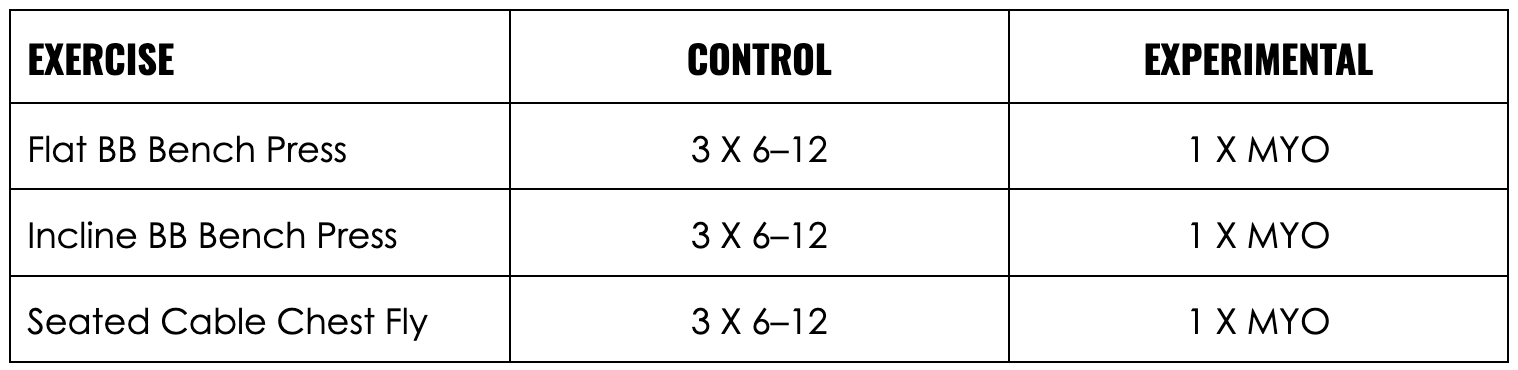
2 mins rest between sets (control); 3 mins rest between exercises
Below is an overview of the Myo-Reps protocol:
Table 2.
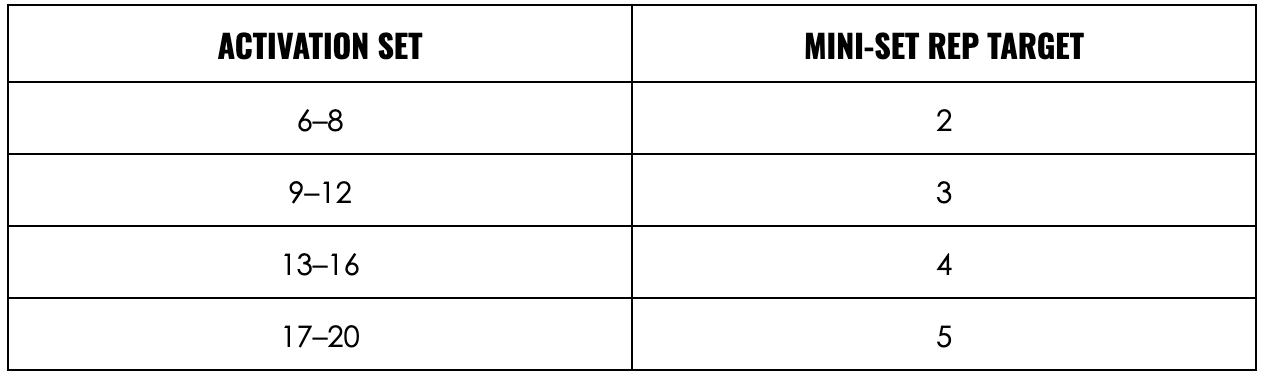
Subjects in the experimental group would perform an “activation set” with a 6–12RM load, rack the weight for a 40s rest period, unrack the same load and perform “mini sets” to a predetermined rep target (based on their activation set performance). Mini sets were separated by 20s rest periods and were repeated until the rep target could no longer be achieved. Note: if a subject made it to a 5th round, that mini set was taken to concentric failure. In simple terms, the volume was autoregulated based on that day’s performance capabilities. On days where performance was good, they did more and vice versa. On days where performance was poor, the volume was capped on the given exercise.
Measurements & Results
As mentioned above, the acute portion took measures of session duration, muscle excitation (EMG), and bar velocity, and the chronic portion measured changes in muscle thickness, maximal strength, strength endurance, as well as differences in volume-load (sets x reps x load).
Session Duration
This was the “time” component of the study. Unfortunately, we weren’t able to recruit a volunteer to time every single session of every single subject from start to finish over the 8-week time frame. However, we were able to pull the exercise’s individual set duration from the EMG data (essentially, this also measured the time between the start and end of the set).
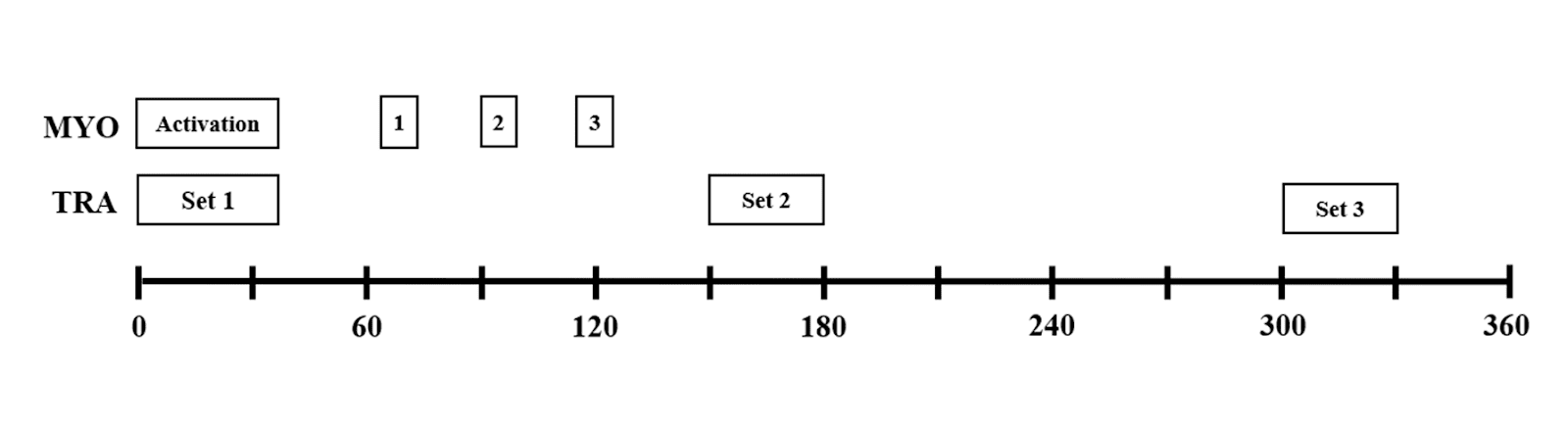
As you can see, the traditional condition took ~332 seconds to complete (this includes each set, plus rest intervals). Following the Myo-Reps protocol only took ~127 seconds to complete, so ~40–45% faster on this exercise. Since the same protocol was used on the following two exercises, you can do the math to figure out the total session’s time difference. This can impact a training session’s “density” (defined as work performed per unit time) and has potential use for preserving stimulus quantity and quality in time-limited scenarios. More on that in a later section.
Muscle Excitation (EMG)
This is often referred to as “muscle activation,” however, that’s not exactly what’s being measured. The general consensus is that a surface EMG is primarily measuring “excitation”, and thus is a more accurate term to use. Despite a lower total number of reps performed in the experimental condition, there was no meaningful difference in muscle excitation. However, the limitations of surface EMG prevent us from making any strong conclusions or inferences (e.g., this does not necessarily say both groups achieved a similar level of motor unit recruitment).
Bar Velocity
As the name implies, a measurement of how fast each concentric part of the rep was moving (measured in meters per second (m/s)).
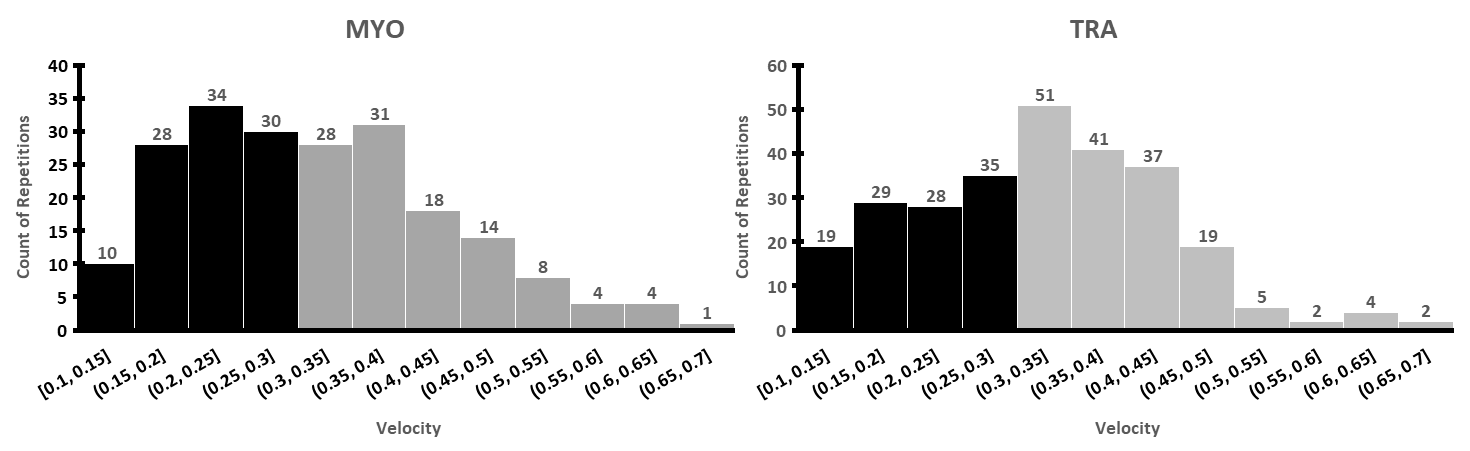
Mean bar velocity did not significantly differ between groups. However, that result may be a product of how the data was analyzed from a statistical standpoint. When zooming in, both groups performed a similar number of slow, near failure reps (despite rep totals/volume-load differing). This was a key finding and is discussed at greater length below in conjunction with the volume-load data.
Muscle Thickness
The “hypertrophy” data.
Measured on ultrasound (US), this is the distance between bone and subcutaneous fat.

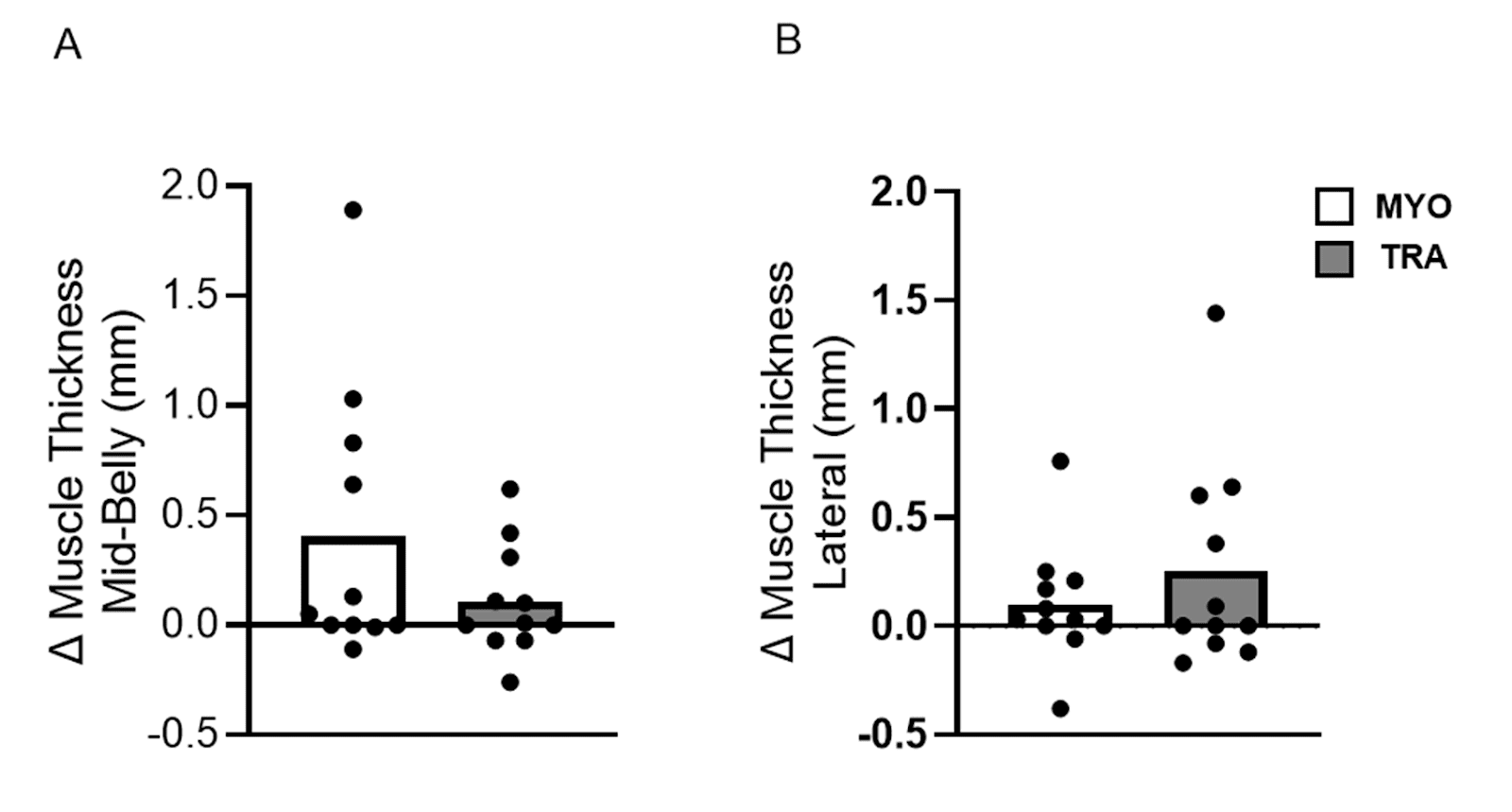
We took US measurements at two sites (mid-belly and lateral regions of the pec). There were no differences between groups. Even though some sites showed slightly different numerical changes, none were statistically significant.
Maximal Strength & Strength Endurance
A 1RM bench press followed by an AMRAP set with 70% their best 1RM.
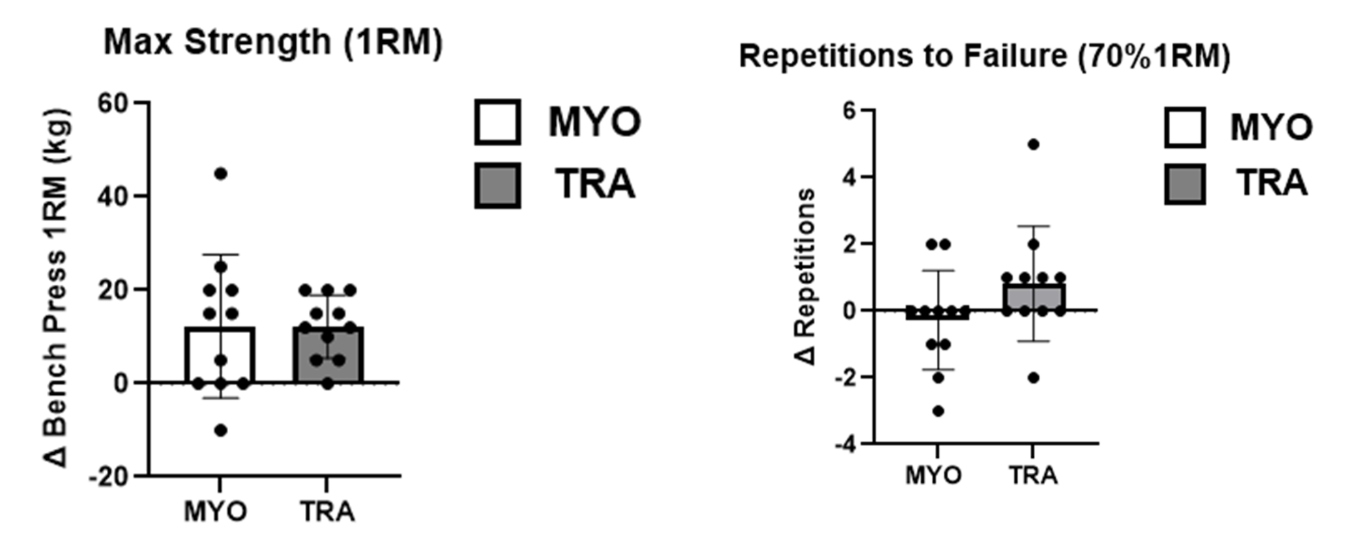
Neither group was favored statistically for either of these tests. Both groups increased their bench press 1RM by ~ 5.5 kg (4–5%) from pre- to post-testing, so both training programs were just about as effective in producing results (note: the perceived differences in the second figure are due to the graph’s scale). This is likely because both groups were using a similar training load relative to their 1RM, so both groups were just about at the same spot on the specificity continuum relative to these tests. Prior strength training data suggests load exposure is key for improving strength at a given %1RM…essentially, if you want to improve strength at higher %’s of 1RM, you have to train with those loads etc.
Volume-Load
The total (tonnage) number of the subject’s sets x reps x load across the entire chronic portion of the study (then summed for both groups).
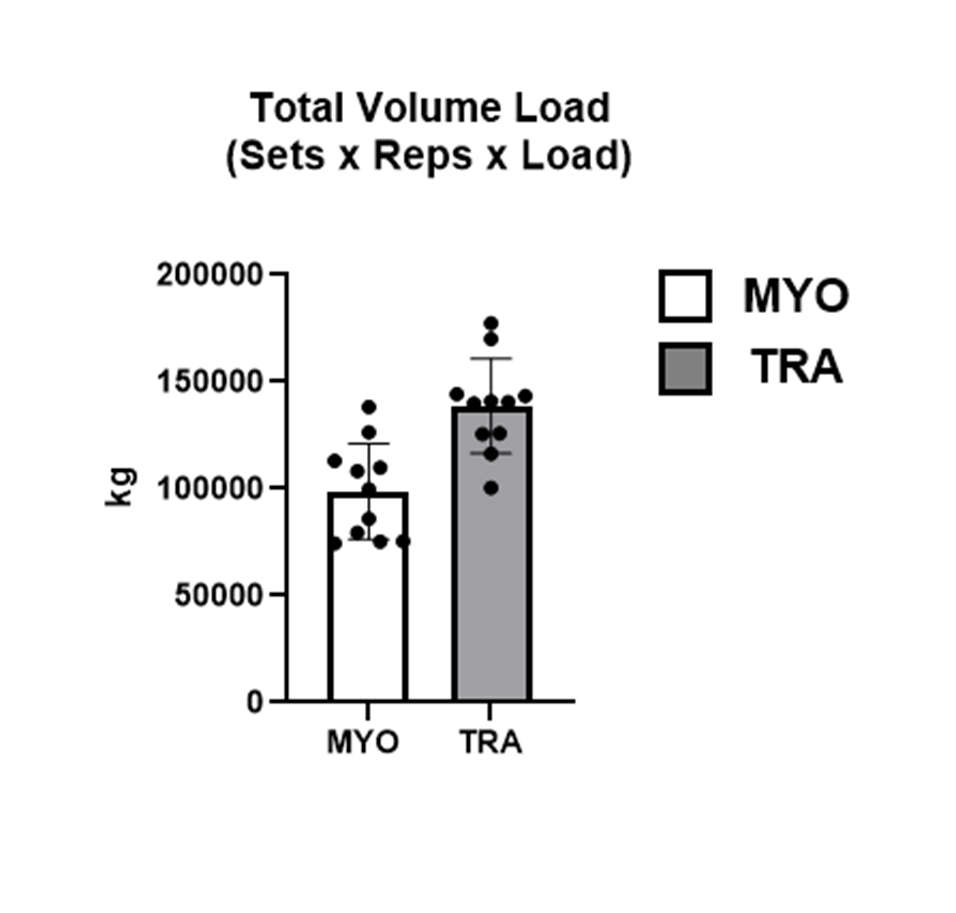
Despite outcome similarity across most measurements, the Myo-Reps group totalled ~30% less volume-load.
Over the 8-week period:
MYO VL: ~98,000 kg
TRA VL: ~138,000 kg
If you’ve been around the evidence-based community for any length of time, you probably understand that this isn’t anything groundbreaking (inherently). Currently, the general consensus is that “number of hard sets” (i.e., sets with a sufficient proximity to failure) is a more accurate measure of stimulus compared to volume-load when analyzing a program from a bird’s eye view.
Just for context, you could accumulate a higher volume-load simply by doing a higher rep set (even though the training load is lighter):
Session 1: 3 x 10 x 100 lb = 3,000
Session 2: 3 x 12 x 90 lb = 3,240
*assuming same prox. to failure.
Despite a 7.4% difference in this example, prior data on rep rangers would tell us this probably results in equivocal growth outcomes over time. Again, nothing groundbreaking. However, a 30% difference may be worth another look, especially considering similar training loads/rep ranges were used in both groups.
The acute bar velocity data can show us where the two groups differed in volume-load:
With both groups producing a similar number of reps below 0.3 m/s, we can say they likely performed a similar number of reps beyond a “sufficient” threshold/proximity to failure. In simplest terms, the groups differed where it didn’t “count” as much, but eventually got to a similar place by the end of the protocol and end of session. For muscle growth, this is likely what matters most, at least in the short-term.
This may also call into question the necessity of equating volume-load between conditions when examining the effectiveness of a training technique on muscle growth. It’s standard practice for researchers to design training studies in such a way that ensures a similar product of sets x reps x load and it often decreases ecological validity (i.e., gives us study designs that don’t reflect real world training scenarios).
Final Thoughts & Application
First, it’s important to note that this is just a single study. In science communication, it’s usually best practice to wait for additional data to be published/produce a trend before making strong conclusions (this can also serve as a guide if you’re trying to decipher credible information online). However, there’s still a lot of ideas we can pull from the data (just take it for what it is).
When looking at the velocity and volume-load data in conjunction, we can see what’s likely the driving factor behind chronic adaptation.
I think it’s worth reiterating: Myo-Reps relies heavily on autoregulation to determine a given day’s dosage–theoretically, you could have a day where you perform an activation set and only make it through one mini set and have to stop the exercise due to poor performance. On the opposite end, you may be able to grind out 5 mini sets if your recovery and performance are great that day. Interestingly, we never really saw that sort of variability from the same subject (though, some were consistently better at racking up mini sets than others). Interestingly, the most common pattern we saw went something like:
“Activation set” x 11, 12 or 13, plus 2 or 3 mini-sets (on average)
When comparing the two groups with that in mind, one could speculate they had an extremely similar number of failure points. To give a visual representation:
Traditional/Straight Set Group
Set 1 x 6–12 @ concentric failure
Set 2 x 6–12 @ concentric failure
Set 3 x 6–12 @ concentric failure
*note: same load used on S1–3, so S1 was as close to a 12RM as possible.
**typical performance often went: 12RM, 9, 6
Myo-Reps Group (average performance)
Activation Set x 12 @ concentric failure
Mini-Set 1 x 3
Mini-Set 2 x 2, or 3 @ ~0 RIR likely if concentric failure was not reached
Mini-Set 3 x 2 @ concentric failure
In an attempt to standardize as many variables as possible, everything was taken to concentric failure (with the exception of the mini-sets that were deliberately performed to a rep target). When comparing failure points between both conditions, we see three obvious failure points in the straight set group. In the Myo-Reps group, we see two obvious failure points (first and last sets). Importantly, the second to last mini set was likely ~0 RIR based on how the final mini set usually went. Although it’s not concentric failure, it’s probably close enough from a stimulus standpoint.
I wanted to highlight this point because it wasn’t included in the paper (due to the inferences/speculation required, degree of uncertainty, and individual variability). For those of you who are experienced with this form of training, you’ll probably agree with the assumption. So if you’re someone who consistently cannot maintain performance across multiple mini sets, your results may vary (just make sure you accumulate a similar number of failure points and you’ll be fine).
When applying Myo-Reps (or any validated training technique for that matter), understand that “equivocal outcomes” does not mean a lack of potential reason for use (quite the opposite). If your training sessions are time limited, using Myo-Reps can be an effective way of achieving a similar stimulus in less time by increasing session density.
If you’re simply looking to change something in your training, this can be a great way to implement variation in a way that’s at least just as effective as using straight sets (so you don’t have to be in a time crunch to use this training technique). To add, if you find your sessions have been dragging on lately or you have a laundry list to get through, implementing Myo-Reps on some of those movements can speed things along. This is extremely helpful for people who can only train ~2–3x/week but still want to maximize outcomes.
